

Standing all day on a hard floor is worse than sitting all day. Most people work that out in the first week, buy the cheapest anti fatigue mat they can find, and stop thinking about it.
That is the mistake. A standing desk mat is not one product. It is three, and they solve different problems. Pick the wrong kind and you will stand on it less, not more.
First, Three Kinds of Standing-Desk Mat
Before any brand name matters, decide which of these you want. Anti-fatigue standing mats fall into three groups, the labels get used interchangeably by the people selling them, and standing mats designed specifically for standing desks are only one of the three.
| Type | What it does | Best for |
|---|---|---|
| Flat mat | Cushions the floor. Nothing else. | Most people, most desks |
| Terrain mat | Raised features encourage you to move | People who plant their feet and stiffen up |
| Balance board | Actively unstable. You are always adjusting. | Active standing, minutes at a time |
For most people working at a standing desk, the answer is a flat mat. Non-flat anti-fatigue mats with a mound in the middle are genuinely useful if you never shift your weight, but they are a bigger object and they will not tuck under a desk that folds. A standing desk mat balance board is a different product wearing the same label.
One clarification before the list. A desk pad is the felt or leather sheet that sits on top of your desk under a keyboard. A floor mat is what you stand on. They get sold as "desk mats" interchangeably and they are not the same thing.
The 10 Best Anti-Fatigue Standing Desk Mats
1. Lillipad Standing Mat
Best Anit-Fatigue Mat for a folding or floor-to-standing desks
Editor's Choice
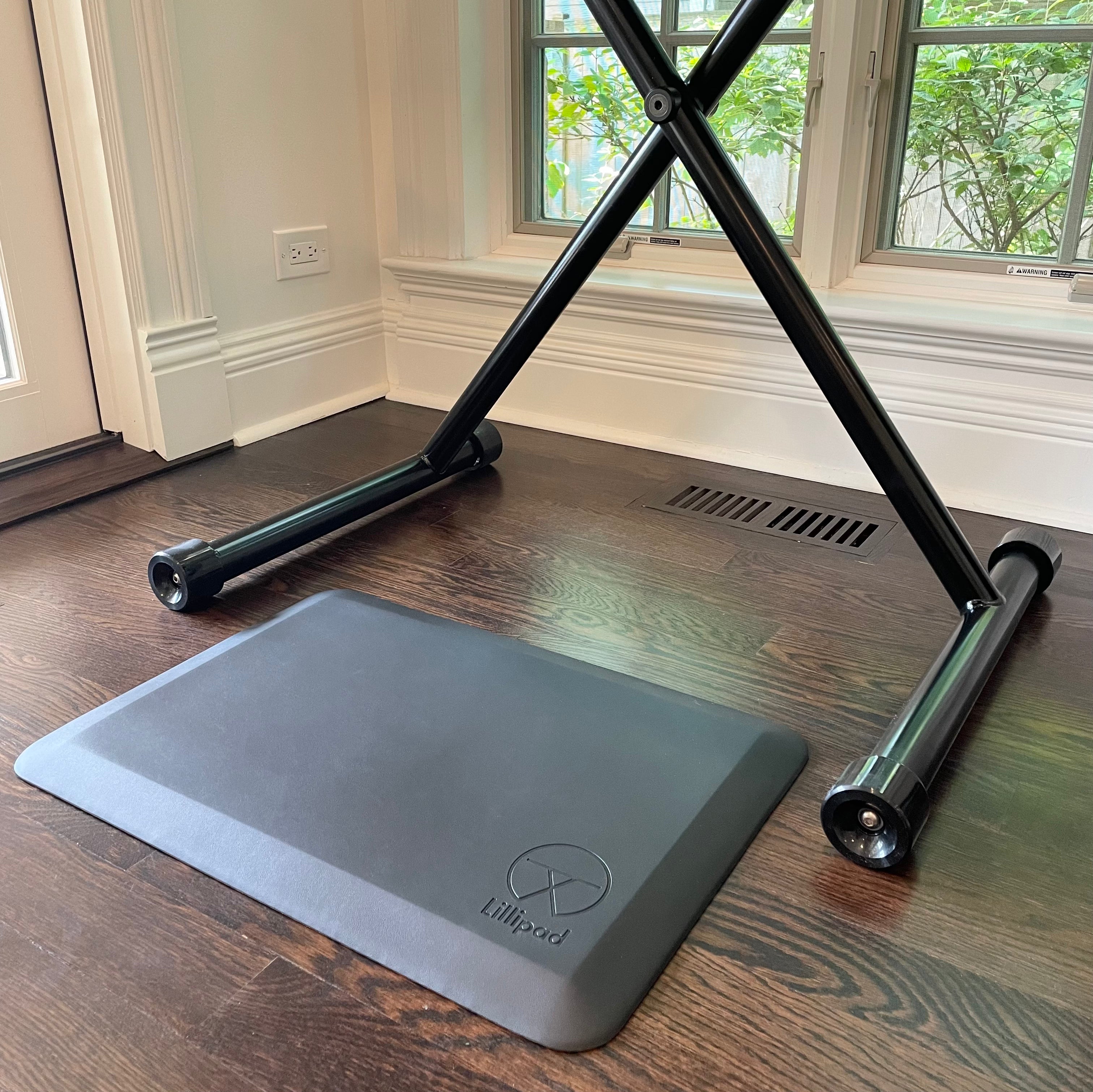
Almost every anti-fatigue mat on the market assumes your desk never moves. This one does not. At 24 inches by 17 inches and 0.6 inch thick, weighing 1.6 lbs, it is deliberately compact, because it is built to sit inside the Lillipad leg frame at any height from floor level to standing. When the desk folds away, the mat goes with it.
That compactness is the trade and it is worth being straight about. If you have a fixed workstation 36 inches wide or more, look further down this list. If your desk folds, rolls, or drops to floor height, a full-size mat is the wrong shape and you will end up kicking it into a corner.
Flat surface, beveled edges, black with a recessed logo, and easy to clean with a damp cloth. Ships from Milwaukee with a 60-day money-back guarantee. See the Lillipad Standing Mat.

Pros
- Cushioned anti-fatigue surface for more comfortable standing
- Compact footprint fits neatly beneath a standing desk
- Lightweight and easy to reposition throughout the workday
- Low-profile design provides cushioning without feeling bulky
- Designed to fit comfortably within the desk frame
- Simple black finish works with most office setups
Cons
- Compact by design, so users looking for an oversized floor mat may prefer a larger footprint
2. Ergodriven Topo: Contoured Terrain for Active Standing
The Ergodriven Topo takes a different approach from a traditional flat standing mat. Its contoured surface includes raised terrain, a center mound, side rails, and other areas designed to encourage users to change foot position and shift their stance throughout the day. Ergodriven describes it as a “not-flat” anti-fatigue mat made specifically for standing desks. The full-size Topo uses polyurethane foam and measures 29 inches wide by 26.25 inches deep, with a smaller Topo Mini also available for tighter workspaces.
This type of design makes sense for someone who wants more foot movement while standing and does not mind a textured surface beneath the workstation. Compared with a conventional flat mat, the terrain creates more places to reposition the feet, stretch, or change stance while working.
3. WellnessMats: Premium Polyurethane Anti-Fatigue Mat
WellnessMats focuses on traditional flat anti-fatigue mats made from one-piece polyurethane rather than foam, PVC, or layered gel construction. The company offers multiple sizes for office and standing desk use, along with 3/4-inch thickness, beveled edges, and non-slip top and bottom surfaces.
The main appeal is durability and a firm, consistent standing surface. WellnessMats states that its polyurethane construction is designed not to compress, delaminate, or curl over time. This is a more conventional option for users who want substantial cushioning without raised terrain or balance features.
4. Vari ActiveMat: Flat Mat for a Full-Size Standing Desk
The Vari ActiveMat is a straightforward anti-fatigue mat designed to sit beneath a standing workstation. Vari lists the mat at approximately 32 inches wide by 20 inches deep with a 0.75-inch profile, giving users more side-to-side standing space than a compact mat.
Its flat surface and slip-resistant design keep the experience simple. There are no balance elements or raised terrain to interact with, making it better suited to someone looking for a conventional cushioned surface beneath a larger adjustable desk.
5. UPLIFT Standing Desk Mat: Gel Cushioning With a Heel Grab
UPLIFT's Standing Desk Mat uses a 0.75-inch rubberized gel core and adds a practical heel-grab section along the edge. The heel grab allows users to pull or reposition the mat with a foot when transitioning between sitting and standing instead of bending down to move it by hand.
This makes the UPLIFT option especially relevant for workstations where the mat is regularly moved out of the way for an office chair. Beveled edges are also incorporated into the design to make stepping on and off the mat easier.
6. Imprint CumulusPRO: Traditional Flat Polyurethane Mat
The Imprint CumulusPRO is another traditional flat anti-fatigue mat built around solid, one-piece polyurethane construction. Imprint uses its Cushion-Core technology with a high-density core designed to maintain its support over time.
The Professional version is available in sizes including 20 by 30 inches, while larger Commercial versions provide additional standing space. The mats also use beveled edges and a non-slip bottom. This is a conventional choice for someone who prefers a flat standing surface instead of contoured terrain or a moving platform.
7. ComfiLife Anti-Fatigue Mat: Accessible Cushioned Option
The ComfiLife Anti-Fatigue Mat sits on the more affordable side of the category and follows the familiar flat anti-fatigue mat design. It is commonly positioned for use in kitchens, offices, and standing work areas where users want additional cushioning over a hard floor.
Its appeal is simplicity rather than specialized standing desk features. There is no contoured terrain, balance mechanism, or workstation-specific movement system, making it an option for shoppers primarily looking for basic cushioning at a lower price point.
8. iMovR EcoLast: Firm Polyurethane Mat for Extended Standing
The iMovR EcoLast line uses 3/4-inch solid polyurethane construction and is offered in several sizes for standing workstations. The larger Premium versions provide broader standing areas, while the portable EcoLast measures 18 by 22 inches and includes an integrated carrying handle.
iMovR emphasizes durability, firmness, and resistance to problems such as edge curling, punctures, delamination, and loss of cushioning. Its beveled edges and flat surface make it another option for users who prefer a more traditional anti-fatigue mat rather than an active terrain design.
9. Balance Boards: A More Active Alternative to a Standing Mat
Balance boards are often compared with standing mats because both are used beneath adjustable desks, but they serve different purposes. Rocker and wobble boards intentionally move beneath the feet, requiring the user to continually adjust balance and body position.
That additional movement appeals to people who want a more active standing experience, but it also requires more attention and effort than standing on a flat mat. Someone who wants straightforward cushioning during longer work sessions may prefer a traditional standing mat, while a balance board is better treated as a separate type of standing desk accessory.
10. Kitchen Anti-Fatigue Mats: Longer Mats for Broader Floor Coverage
Kitchen anti-fatigue mats use many of the same cushioning concepts as office standing mats, but they are usually shaped around counters, sinks, and food-preparation areas. That often means longer, narrower dimensions designed to let someone move laterally across a larger work surface.
A kitchen mat can still work beneath a standing desk when the dimensions fit the workstation. The tradeoff is that these mats are not necessarily designed around desk frames, rolling office chairs, compact footprints, or frequent transitions between sitting and standing.
Ready to Upgrade Your Workspace?
Say goodbye to the discomfort of long hours on your feet
Best Standing Mat